Secure AI agents from build to runtime with Harness Agent DLC, featuring AI testing, AIBOM, Agent Discovery, AI Firewall, and AgentTrace.

More teams are building AI agents today. Engineers deploy them into customer-facing production environments, product teams integrate them into customer workflows, platform teams build them for internal use, and even sales, marketing, and support teams are creating agents for their own operations.
Shipping a software update usually follows a known process: build it, test it, deploy it with a script. That process works. It's how the modern software delivery industry was built, and it works because application code is deterministic — test it once and you’ll get the same result next time.
Agents break this model. An agent’s underlying language model decides how to complete a task. But that flexibility comes at a cost. Building an agent is easy. Delivering one safely to production is not.
Today, Harness is extending its platform to cover the full agent development lifecycle. With Harness Agent DLC, you can now build, test, deploy, operate, and govern agents through the same platform you already use for your applications — with the same controls, pipelines, and governance you apply to everything else you ship.
AI agents behave differently. They dynamically select tools, invoke models, coordinate with other agents, and adapt their execution paths based on context. Each time an agent runs, it can make different choices even with the same input. That makes their behavior inherently unpredictable and can lead to significant differences in cost, latency, reliability, or risk. Traditional testing and governance playbooks no longer apply.
According to Gartner®, “only 8% of organizations have agentic AI in production”. Agents aren’t making it to production because organizations can't apply the same security, governance and quality guardrails they rely on for traditional software. The risk is too high to ignore. A rogue agent in production can expose customer data, violate a compliance policy, or make unauthorized decisions. In financial services, healthcare, and travel, that's not a bad week. It's a regulatory event or a headline. Incidents are no longer reproducible on demand. Teams building agents need a way to ship them with the same confidence they ship everything else.
Build
You build agents with the same coding tools you already use. Harness Continuous Integration (CI) builds them into deployable artifacts, just as it builds any other service. No new build system to learn. The agent is just another standard microservice that goes through CI.
Test
Testing an AI agent requires different tools versus traditional software. With software, an input generates a predictable output. AI agents are inherently non-deterministic. A single prompt can yield multiple correct, yet entirely different, outputs. A response might be factually correct but delivered in the wrong tone or return a plausible wrong answer.
Traditional testing falls short in this new reality where a test is no longer a pass fail but a scored spectrum. Teams need testing capabilities built for agents that can be integrated cleanly into their governed delivery pipelines.
Harness AI Evals (NEW) makes the core agent quality measurable, allowing for agent-aware quality gates in your CI/CD pipelines. With AI Evals, changes to your agent (or underlying model) are evaluated first against your standard data sets and model outputs. The output is evaluated across many dimensions, including correctness, performance, and safety. Teams can then use the scores as quality gates in their CD pipelines to simplify release decisions. Then, production data can be fed back in, improving your testing based on real inputs. Learn more about Harness AI Evals.
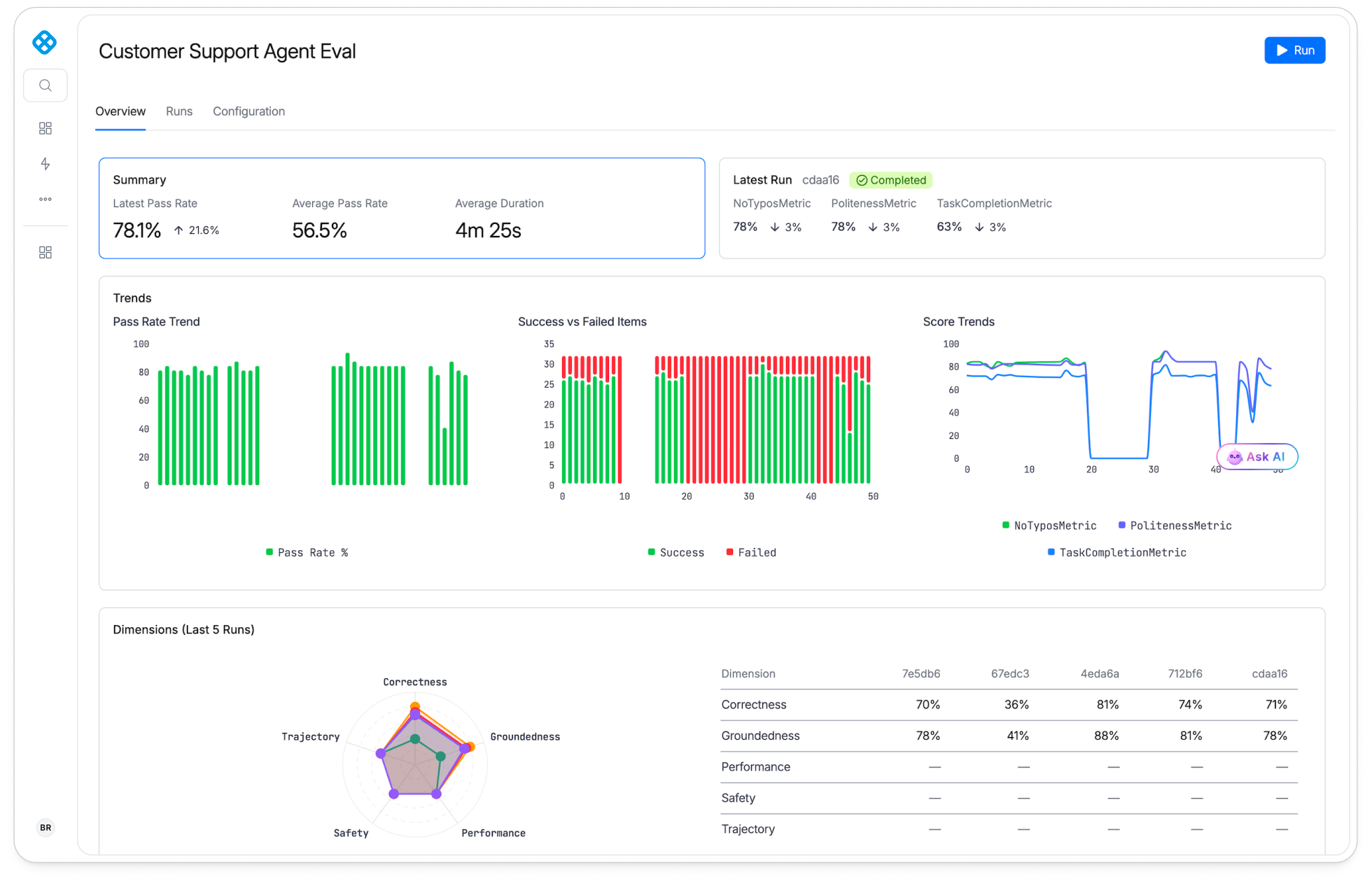
Harness AI Test Automation (AIT) validates that the agent works within an application’s chat interface using AI assertions. Instead of writing brittle code, testers use plain English assertions to describe a good response. AIT emulates a real user via the browser, requiring no API hooks or direct model access.
You cannot isolate agent validation from how you deliver the rest of your system. Natively binding backend logic evaluation with user-centric UI testing inside your delivery lifecycle ensures your agents are actually improving, not just running and returning answers.
Store
Unlike traditional software, AI agents are composed of many independently evolving artifacts, including agent definitions, prompts, skills, MCP servers, models, and policies. These artifacts are developed, evaluated, and updated independently, yet together determine how an agent behaves in production. As they're built, evaluated, and reused across teams, the Agent DLC needs more than a repository. It needs a trusted system of record that manages the complete release definition of an AI agent.
Harness Artifact Registry provides a centralized registry for AI and software artifacts, preserving their versions, provenance, dependencies, and promotion history. By governing the complete set of artifacts behind every agent release, teams can confidently compose trusted AI agents, reuse approved components, and promote reproducible agent deployments.
Deploy
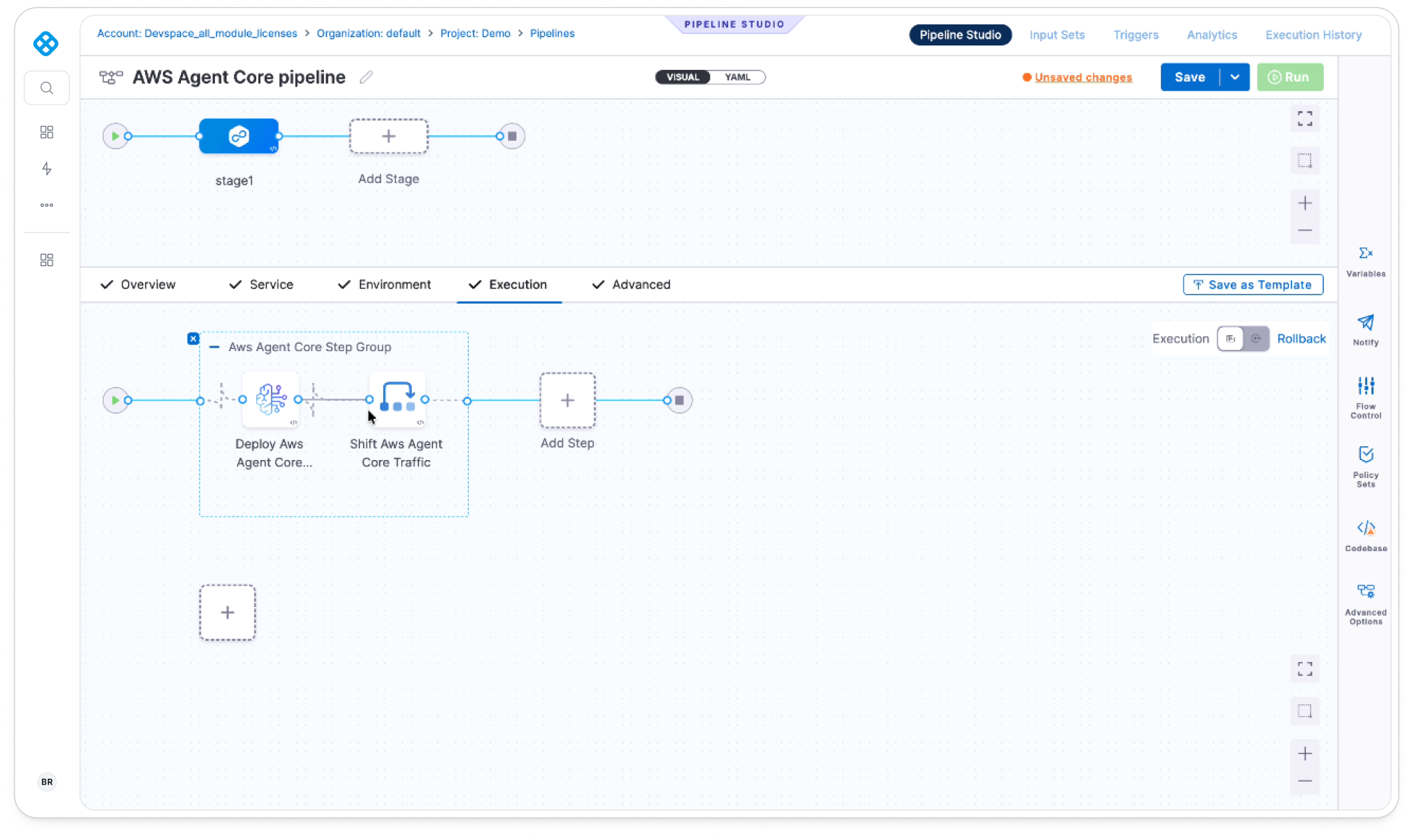
Most AI agents in production run either as containers on Kubernetes or on managed runtimes like Amazon Bedrock AgentCore. Harness Continuous Delivery (CD) already covers the Kubernetes path with canary releases, progressive rollout, automated rollback, approval gates, and policy guardrails. Until today, deploying to a managed runtime typically meant a separate cloud-specific workflow, outside your pipelines and governance.
Agent Deployments (NEW) extend that same governance to managed agent runtimes, starting with Amazon Bedrock AgentCore and Google’s Agent Runtime. Agent Deployments now run as a stage in the same Harness CD pipeline as your services, with no new scripts or tooling required. Because the agent deploy is a stage in that pipeline rather than a separate workflow, release orchestration can sequence backend, frontend, and agent code into a single release, instead of running the agent deploy on its own, separate from the other two.
In addition, the same OPA policy-as-code framework that governs your backend and frontend now governs your agent deployments. You can now cap CPU or memory consumption, restrict which models agents can call, or block anything outside an approved list. Agent Deployments also integrate directly with Harness AI Evals and other LLM evaluation frameworks, such as Deepeval. This closes the gap between an agent that deploys successfully and one that runs reliably in production. Learn more about AI Agent Deployment.
Operate
Once an agent ships, the same platform that manages your services manages your agents. Harness already handles cost visibility, runtime release management, and experimentation. All of these capabilities now extend to cover agents.
AI Cost Management extends the cost visibility, attribution, and governance you rely on for cloud spend to every agent, model, and provider, so you know what agents cost and are better able to keep that spend under control.
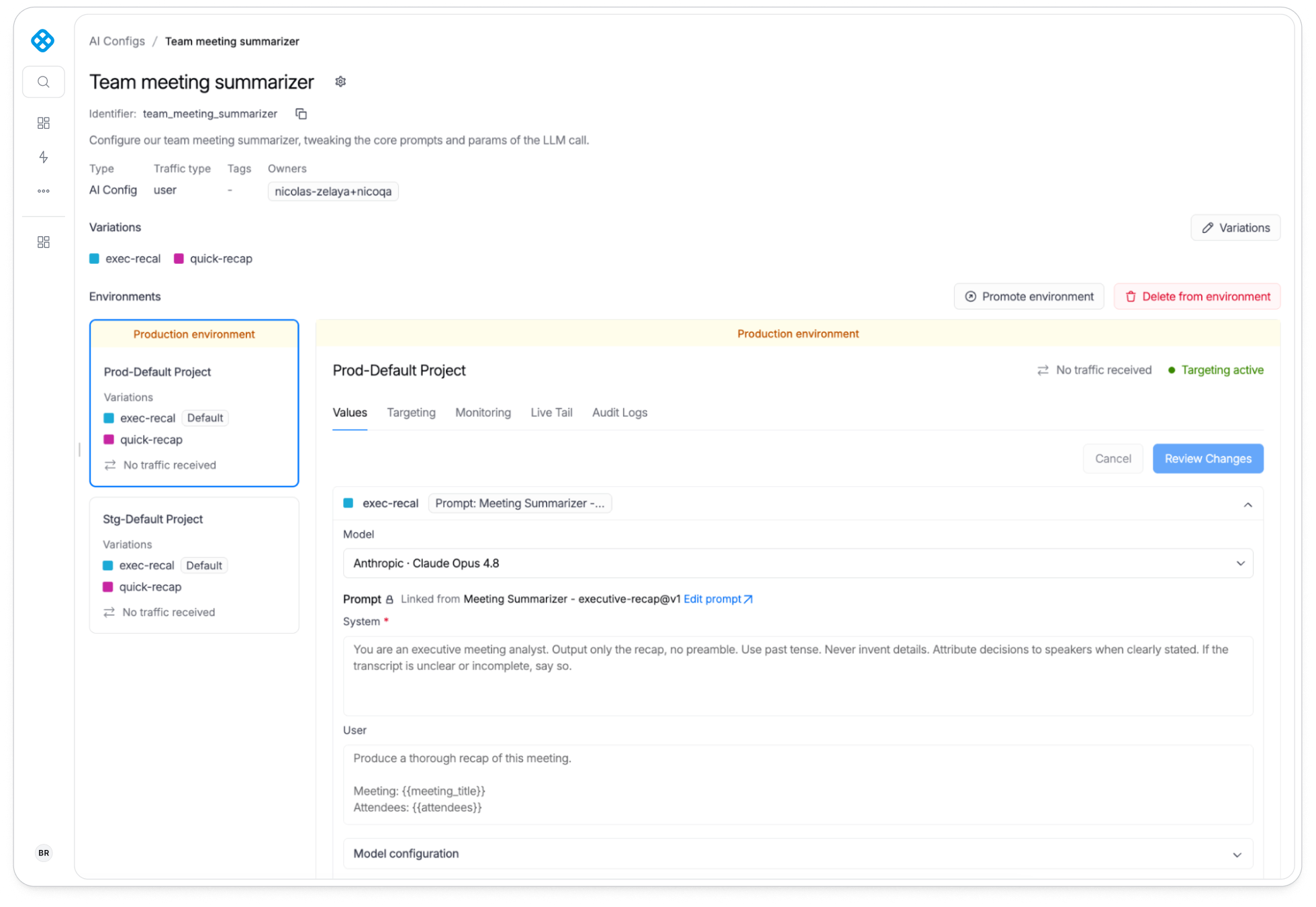
AI Configs (NEW) support the release and management of prompts and model changes at runtime, backed by the same feature flagging infrastructure your teams already rely on. Run controlled experiments to see which AI behavior performs best, then promote the winner with confidence. If it doesn’t improve the customer experience, roll back instantly without redeploying. Learn more about AI Config Management.
Govern
Building, testing, and deploying AI agents safely into production is only part of the challenge. Organizations also need to know which agents exist, who owns them, and whether an agent already solves the problem they're about to tackle. Without that visibility, organizations risk unnecessary cost and operational complexity.
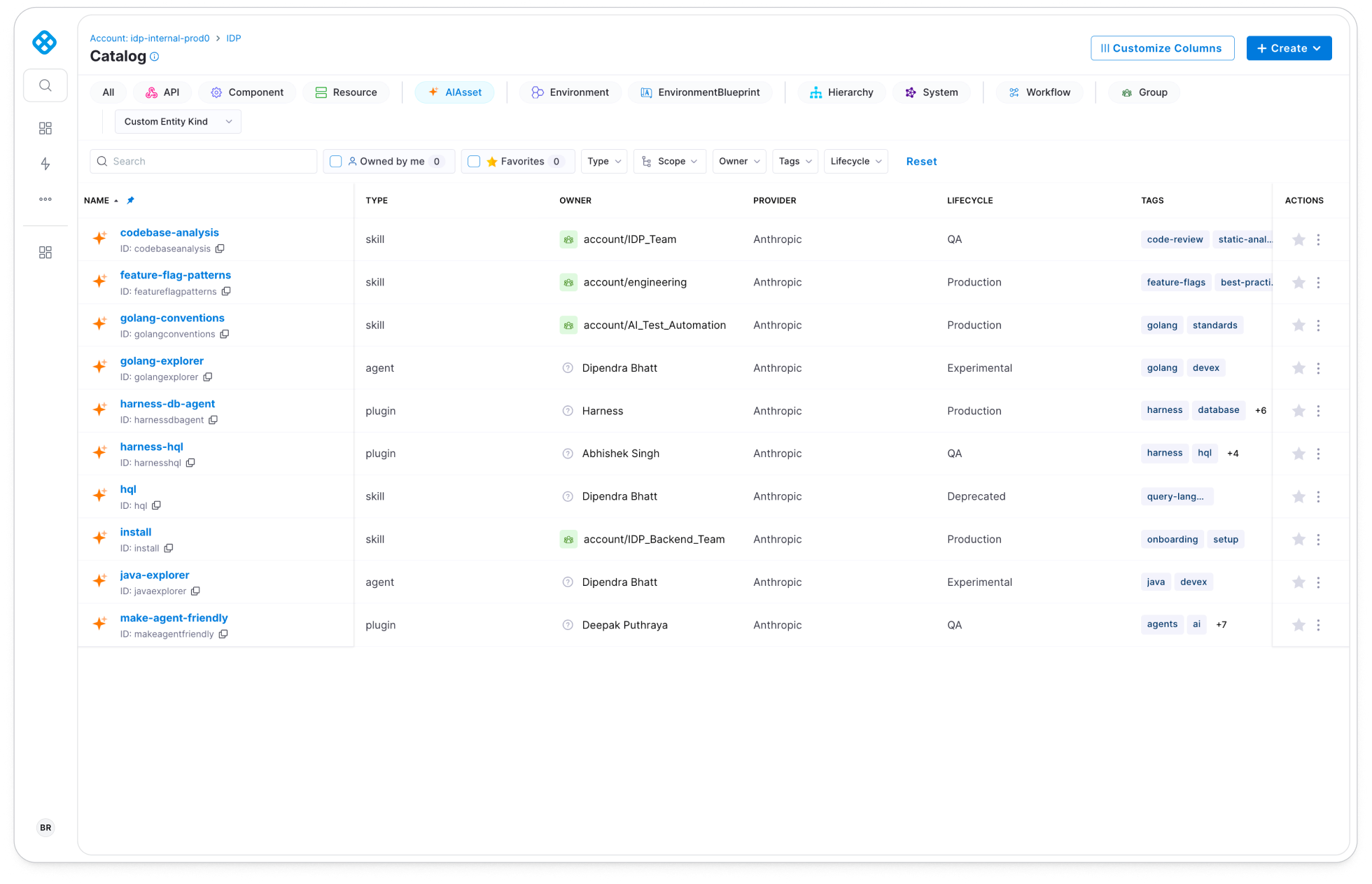
AI Asset Catalog (NEW), part of the Harness Internal Developer Portal, makes sure every agent in your organization has an owner. It auto-discovers and registers your agents, skills, and plugins from your source code repositories. Each AI asset is stored with its full instruction set and linked to its owner and dependencies. Developers can easily discover what agents and skills already exist before building new ones, cutting down on duplicate work and sprawl. With out-of-the-box and custom scorecard checks, platform teams can define and enforce standards so AI assets are governed just like any other software component.
Agent Security: Woven Into Every Stage
Security runs through every stage of the Agent DLC — build, test, deploy, operate, and govern — and requires a different approach than traditional software security. Agents reason and act at runtime in ways no static scan can anticipate. They dynamically expand their attack surface by connecting to tools and APIs, spawn sub-agents without a human in the loop, and inherit trust from every model and dependency they touch. Traditional security wasn't built for any of that.
New agent security capabilities shift left to limit what agents can do before they ship, and shields right to enforce policy on agents already running in production.
Shift-left
- Primitive Scanning (NEW): scans skills and prompts with Harness SAST and packaged models with Harness Security Testing Orchestration to catch misconfigurations and other risks before an agent is built or deployed.
- AIBOM (NEW): Harness Supply Chain Security extends the traditional SBOM to capture every model, tool, and dependency an agent was built with.
- Harness AI Testing (NEW): tests agents for adversarial inputs, unexpected behaviors, and policy violations across the OWASP Top 10 for LLMs.
Shield-right
- Agent Discovery and Posture Management (NEW): Harness AI Discovery continuously surfaces agents as they’re invoked, maps how they connect and orchestrate work, and assesses their posture across your org.
- Harness AI Firewall (NEW): enforces policy continuously against prompt injection, tool misuse, and data exfiltration while the agent runs.
Learn more details in our blog.
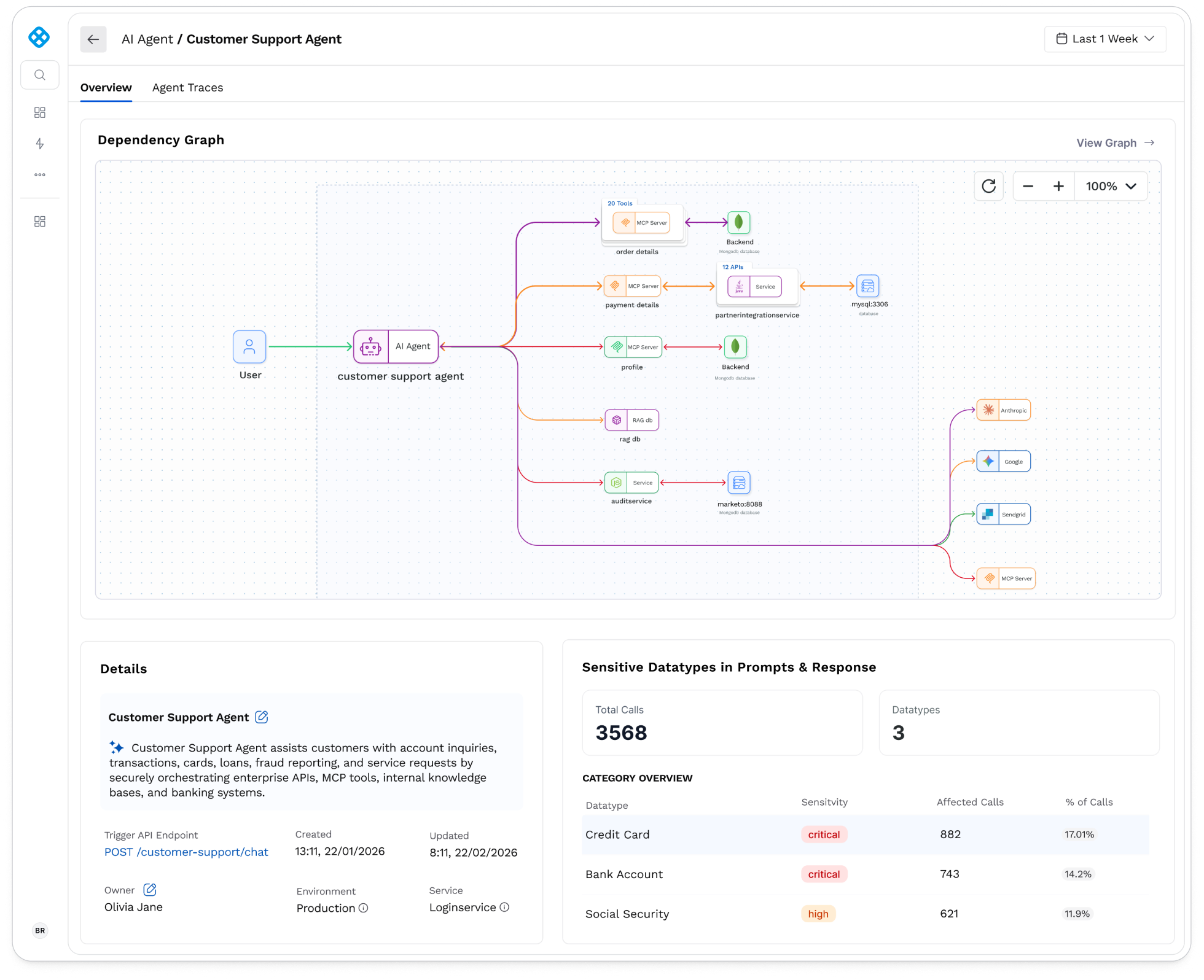
AgentTrace Provides End-to-End Visibility Across Every Execution
As organizations move AI agents into production, those agents are increasingly reviewing code, remediating security issues, assisting customers, and automating complex workflows. Yet most organizations have little visibility into how those agents actually operate.
Harness AgentTrace (NEW) captures execution at the run level and across full sessions, so teams can understand both what happened in a single agent run and how behavior evolves across an entire user interaction.
With AgentTrace, organizations can understand how an agent behaved and what influenced its path, identify performance bottlenecks and failure points, compare execution quality across models and prompts, and establish governance for AI systems running in production.
AgentTrace serves as the layer that connects every stage of Harness Agent DLC, providing the telemetry and audit trail consumed across Harness products.
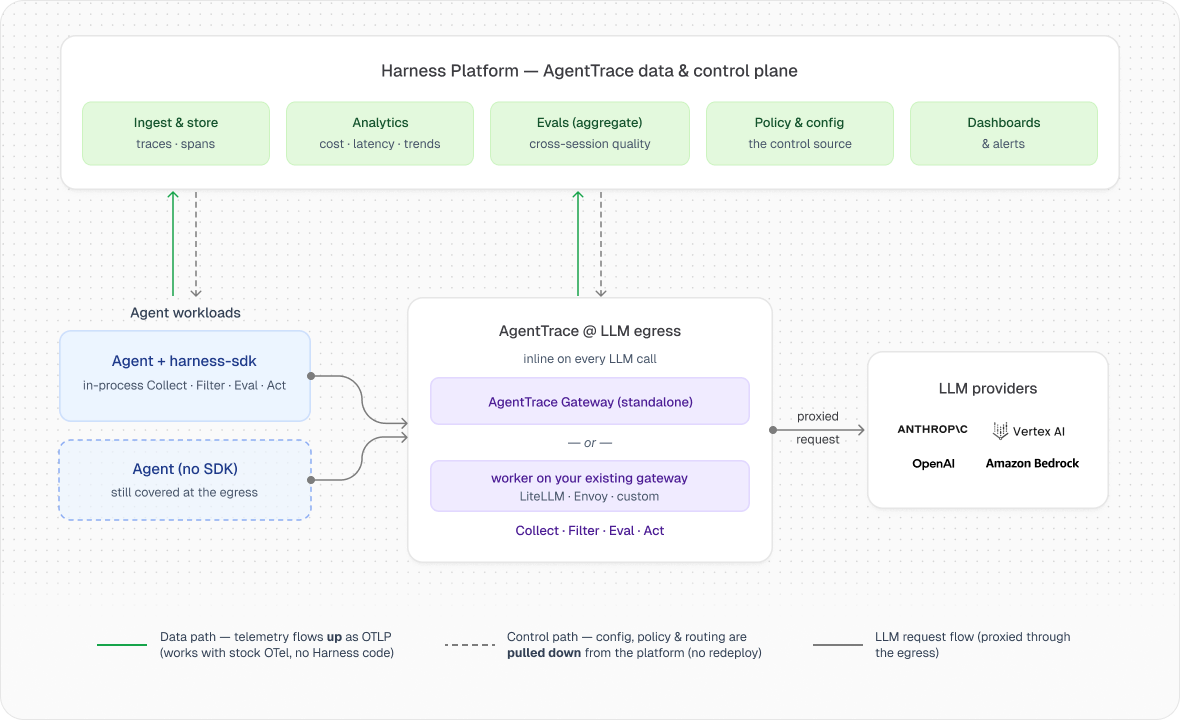
Today, Harness is open-sourcing the foundational components of AgentTrace, including harness-sdk and harness-evals (the open-source SDK on which Harness AI Evals is built), so developers can use the same tracing primitives in their own AI applications. Learn more about Agent Trace.
One platform supporting the Agent DLC
The challenge organizations face today is extending the same software development lifecycle to their agent delivery. That's the truth behind what’s driving Gartner's finding that only 8% of organizations have agentic AI in production.
Today, Harness is launching our Agent DLC to support our customers in successfully delivering AI agents. Everything you’ve done for software delivery over the last decade — governance, orchestration, security, testing — you can now do for agents in the same platform.
Talk to our team about what shipping your first agent through Harness Agent DLC would look like. Book a demo.