Stop manual governance. Harness embeds policy-as-code and auditability directly into your Database DevOps pipeline for consistent, pre-execution control.

Introduction: Governance Must Be Built Into Delivery
Database changes are inherently complex: coordinating schema updates, managing risk, and avoiding downtime all require care. Even when teams improve how they deliver those changes, governance often remains inconsistent, manual, and reactive.
In many environments, governance is treated as a separate layer around deployment. Policies are applied unevenly, approvals become bottlenecks, and audit evidence is assembled after the fact, creating gaps in enforcement and increasing operational risk.
Effective governance must be enforced as part of how changes are delivered. With Harness Database DevOps, governance is built directly into the deployment pipeline, where each change is evaluated against defined policies before execution based on context such as environment, database type, and deployment configuration.
Pre-Execution Governance with Policy-as-Code
The most effective way to enforce governance is to evaluate changes before they are applied.
With Harness, database changes are analyzed prior to execution using policies defined through Open Policy Agent (OPA). These policies evaluate the SQL being applied along with its context, including the target environment and database type.
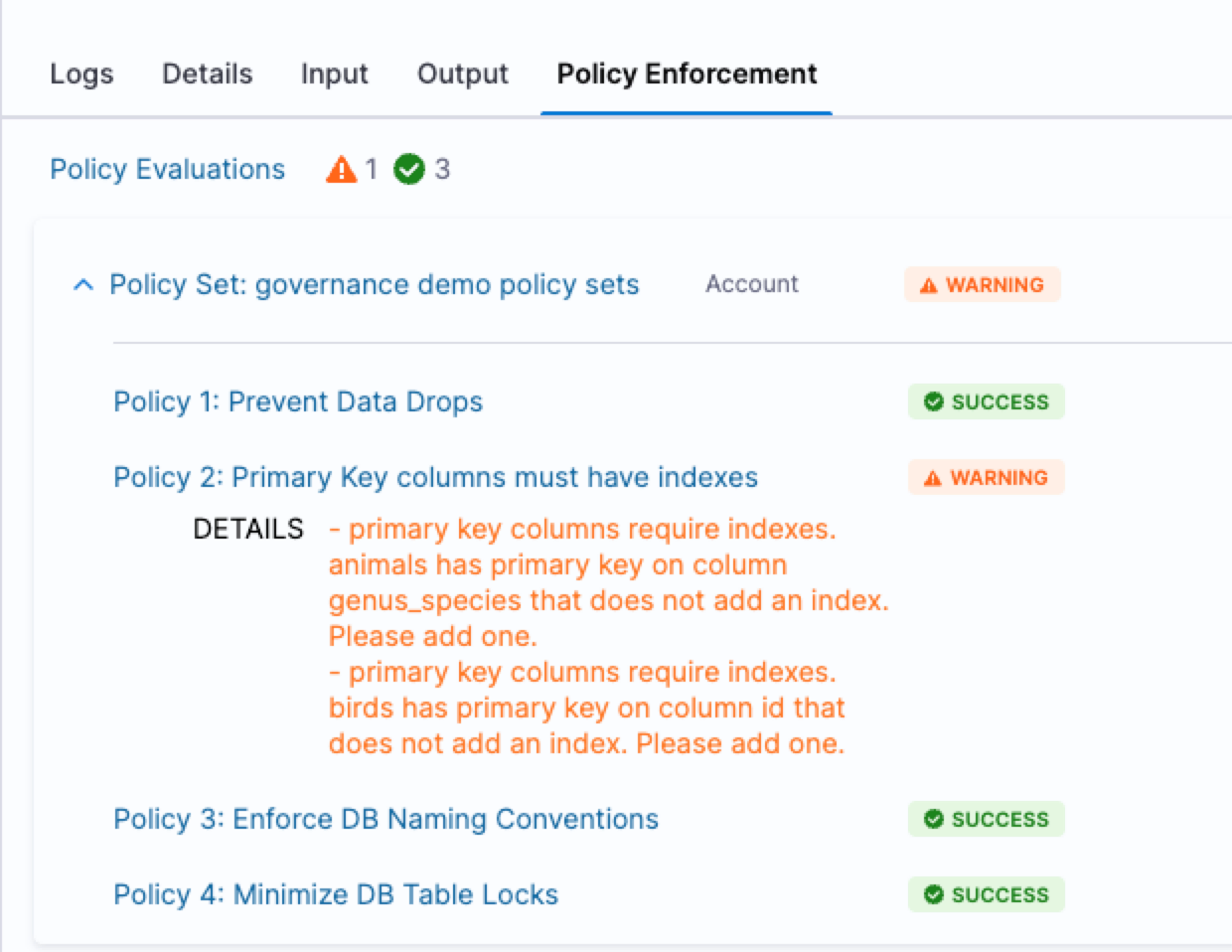
Policies can enforce context-aware rules, such as restricting destructive operations in production while allowing flexibility in development environments. Governance can also be adapted by environment. For example, policies that block deployments in production can surface warnings in lower environments, allowing issues to be identified and addressed earlier.
Because policies are defined as code, they can be versioned, reviewed, and updated alongside application and database changes. This ensures governance is applied consistently across teams and environments without relying on manual enforcement. Harness policies are applied across databases and migration tools, allowing teams to define policies once and enforce them consistently regardless of toolchain.
Governance as a System: Process and Consistency Across Environments
Effective governance extends beyond evaluating individual changes to ensuring that deployments follow the correct process.
Harness enforces this through pipeline-level controls, such as requiring changes to progress through defined environments and applying approvals where needed. These controls ensure that database changes follow consistent promotion paths, such as progressing from development to staging to production.
Governance is applied consistently even in complex environments where multiple teams use different database change tools or databases. Harness provides unified visibility and governance across tools such as Flyway and Liquibase, allowing policies to be defined once and enforced consistently regardless of the underlying toolchain.
By combining policy enforcement with structured workflows, teams can maintain control over how changes are delivered while reducing reliance on ad hoc reviews and manual coordination.
Auditability: Proving Enforcement and Change History
Harness provides a complete record of database activity across environments, including what changes were deployed, how they were executed, and who approved them.
In addition to change history, Harness maintains an audit trail of configuration changes to pipelines, policies, and governance settings. This allows teams to demonstrate that governance controls were consistently applied during a given period, simplifying audits by reducing the need to manually reconstruct evidence for each deployment.
Visibility Across Environments: Preventing Drift
Harness provides centralized visibility into database changes across environments, allowing teams to see what has been deployed where and when.
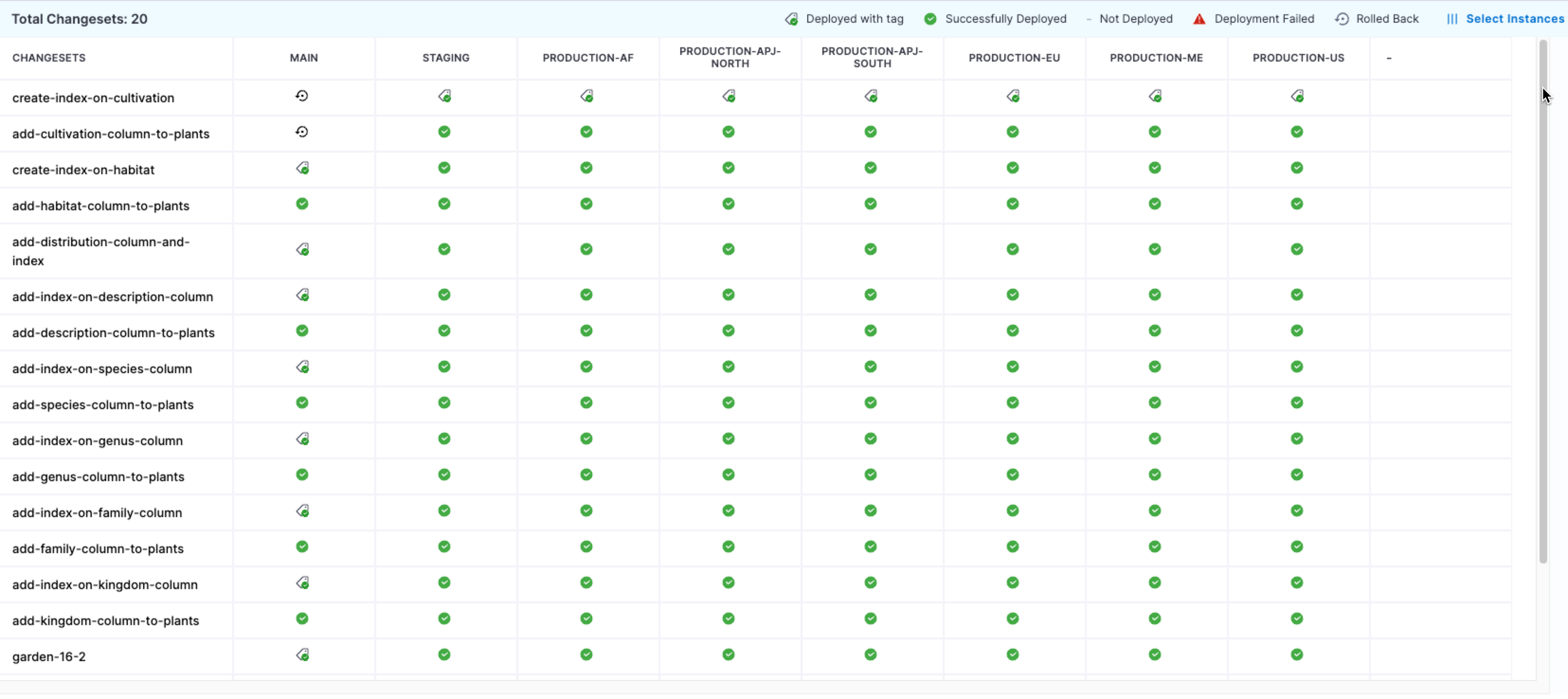
This visibility, combined with enforced deployment workflows, prevents cross-environment drift. Reporting and customizable dashboards extend this further, enabling teams to analyze delivery performance using metrics such as lead time and to track database changes as part of the broader software delivery process.
When used alongside Harness CD, teams can also view combined metrics across application and database changes, providing a more complete picture of delivery outcomes.
Conclusion: Governance That Scales With Delivery
Governance enforced before execution, defined as code, and applied consistently enables both control and scalability. But don’t take our word for it, just ask our customers.
Athena Health: “Harness gave us a truly out-of-the-box solution with features we couldn’t get from Liquibase Pro or a homegrown approach. We saved months of engineering effort and got more for less, with better governance, smarter change orchestration, and a clearer understanding of database state across teams and environments.”
By embedding governance directly into the delivery pipeline, teams can reduce manual oversight while improving compliance, consistency, and delivery speed.